
Walk Before You Hire
By Carlos Acosta
Most Plant Manager searches fail quietly. The candidate interviews well, the résumé checks every box, the references are complimentary, and eighteen months later the operation is still fighting the same fires it was fighting before the hire. The gap is rarely competence on paper. It is judgment in the field, and judgment in the field is nearly impossible to evaluate from behind a conference room table.
Manufacturing leadership is an applied discipline. A Plant Manager’s real job is reading a floor in motion; sensing where flow is breaking down, where a supervisor is covering for a process gap, where “good enough” has quietly become the standard. None of that shows up in a behavioral interview question. It shows up when the candidate is standing on the floor, watching the same operation the hiring team sees every day, and is asked simply: what do you notice?
This idea is not new. Nearly a quarter-century ago, Harvard Business Review published a now-classic piece on rapid plant assessment, the premise that an experienced operations leader can walk an unfamiliar factory floor and, within a couple of hours, form a reliable read on its health: how material and information move, how problems surface, how disciplined the operation is about the fundamentals. The same logic applies directly to hiring. If a seasoned operator can diagnose a plant they’ve never seen, a hiring manager can use that same walk to diagnose a candidate they’ve never worked with.
Why the Tour Outperforms the Interview
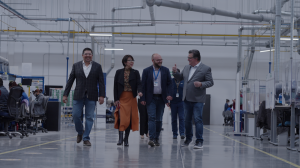
A traditional interview asks candidates to describe how they would lead. A plant tour asks them to demonstrate how they actually see. The difference matters because operational instinct is largely tacit, built from years of pattern recognition, and tacit knowledge rarely survives translation into a rehearsed answer. Put a strong candidate in front of a live production line, and their attention goes where an operator’s attention goes: to the constraint, the workaround, the visual cue that something is being managed rather than solved. Put a weaker candidate in the same spot, and the silence, or the generic commentary, tells the hiring manager just as much.
The tour also strips away polish. Candidates can prepare for “tell me about a time you improved throughput.” They cannot prepare for a live floor they have never seen, which is exactly why it is the more honest test.
Structuring the Walk
 Treat the tour as a structured evaluation, not a courtesy add-on to the interview day. A few principles make it effective:
Give minimal framing going in.
Tell the candidate only what they would know as a new hire on day one, general product, general layout and nothing more. The value of the exercise depends on the candidate encountering the floor cold.
Move at operating pace, not tour pace.
Walk the actual flow of material, from receiving through shipping, rather than a curated path. A candidate’s read of a real, occasionally messy operation is more revealing than their reaction to a showcase area.
Ask open questions, not leading ones.
“What stands out to you here?” and “What would you want to understand better?” produce more signal than “Do you see the bottleneck at station four?” The second question hands the candidate the answer.
Build in pauses for narration.
Ask the candidate to think out loud as they move. Explain what they’re looking at, what it suggests, what they’d want to verify before drawing a conclusion. The narration is often more diagnostic than the final observation.
What to Listen For
Strong operational candidates tend to organize what they see around a consistent set of fundamentals, whether or not they use this language explicitly:
- Flow and constraint. Do they notice where work-in-process is piling up, where a line is waiting on the line before it, or where a single station is quietly setting the pace for the whole area?
- Visual discipline. Do they register whether performance is visible on the floor — production boards, quality metrics, andon signals — and whether those displays look current or abandoned?
- Condition of the workplace. Housekeeping and organization are not cosmetic to an experienced operator; they read them as a proxy for overall process discipline.
- Problem visibility versus problem suppression. Does the candidate ask how issues get surfaced and resolved, or do they take a quiet floor at face value? The best candidates are naturally suspicious of an operation that looks too calm.
- People, not just process. Do they engage with operators and supervisors along the way, and do they notice morale, engagement, or tension in those brief exchanges?
- Root cause instinct. When something looks off, do they ask “why” more than once, or do they accept the first explanation offered?
None of these observations need to be perfectly correct. What matters is whether the candidate is running the right kind of analysis at all.
Turning Observations Into a Measurable Comparison
The walking tour only earns its value if the hiring team can compare candidates against each other with some rigor, otherwise it becomes an interesting anecdote rather than a hiring input. A few practices make the observations usable:
Debrief immediately, and always the same way.
Within minutes of the tour, ask the candidate to summarize what they saw, in order of significance along with the structure of their answer. Do they lead with a real constraint or with a minor cosmetic issue? That is itself, useful data.
Use a short, consistent scorecard.
Rate each candidate, independent of narrative impression, against the same handful of categories: flow and constraint identification, visual management awareness, workplace discipline, root-cause questioning, and engagement with floor personnel. A simple 1–5 scale per category, completed by every interviewer who accompanied the tour, turns a subjective walk into a comparable dataset across candidates.
Separate observation quality from communication style.
A quieter candidate who asks sharp, specific questions may be a stronger operational thinker than a confident one who talks broadly but never lands on a real issue. Score what they saw, not how comfortably they presented it.
Follow up with a probing question, not a confirming one.
Once the candidate offers an observation, push once: “What would you check next to confirm that?” or “If you were wrong about that, what would you expect to see instead?” The answer distinguishes a candidate with genuine operational reasoning from one who is pattern-matching a plausible-sounding answer.
Cross-check with the team that hosted the tour.
Supervisors and operators who walked past the candidate often notice things the hiring manager missed, whether the candidate engaged respectfully, asked useful questions, or came across as dismissive. Their impressions are worth collecting formally, not just informally.
Cross-Border Searches: Cultural and Linguistic Considerations
For organizations hiring Plant Managers across the US, Canada, and Mexico, a search pattern that has become increasingly common as nearshoring reshapes manufacturing footprints, the walking tour surfaces a second layer of evaluation that domestic-only searches rarely require: how a candidate will actually operate inside a specific plant’s cultural and linguistic reality, not just its process reality.
A few considerations are worth building into the assessment deliberately:
Language fluency on the floor is a distinct skill from language fluency in the interview room.
A candidate may interview comfortably in English or Spanish and still struggle to build trust with operators and supervisors who speak the other language as their primary or only one. During the tour, watch how the candidate engages directly with floor personnel rather than relying entirely on an interpreter or the hiring manager to bridge the conversation. The comfort, or discomfort, is immediately visible.
Leadership style expectations differ by market, and a candidate’s instincts should match the plant they will actually run.
Management norms around hierarchy, direct feedback, and decision-making authority are not identical across US and Mexican manufacturing cultures, and a leadership approach that works well in one plant can land as either too rigid or too informal in the other. Listen for whether the candidate frames their observations in a way that assumes one cultural default, or whether they ask questions that suggest genuine awareness that norms will vary by site.
Reporting structure adds a further layer for binational organizations.
Many US-Mexico manufacturing operations have Plant Managers reporting into a US-based corporate structure, sometimes through a regional director who sits in neither country. This creates a communication chain that has to work in both directions — the Plant Manager translating floor realities upward to leadership who may not visit the site often, and corporate direction translating downward to a floor that operates in a different language and cultural context. During the debrief, it is worth asking the candidate directly how they would keep a distant corporate structure accurately informed, and how they would localize direction that arrives without local context.
Treat this as an evaluation criterion, not an assumption.
A candidate’s passport, surname, or self-reported bilingualism is not a substitute for observing how they actually communicate across a language or cultural gap in real time. The tour, again, is more honest than the résumé.
Organizations that build a search around a single geography sometimes narrow their candidate pool to whichever side of the border is easier to recruit in, which can mean settling for the strongest available candidate in one market rather than the strongest candidate for the role. The QualiFind Group’s recruiters work without geographic constraints in this regard — our team has successfully managed manufacturing leadership searches throughout North America, and we source candidates on the basis of operational and cultural fit for the specific plant, not on which side of a border they happen to sit.
A Case in Point
I advised a Chicago-based CHRO several years ago to build a plant walking tour into her organization’s interview process for site-level manufacturing roles. They had multiple plants across the US and Mexico and had experienced both bad hires and retention issues in their operational leadership hires. She agreed to pilot it, saw the difference it made in the quality of her hiring team’s deliberations, and made it a standard step for every plant operations search going forward.
Fourteen years and six Plant Manager placements later, the results have held up well: three of those six hires were subsequently promoted into executive leadership roles within the company, one retired after nine years in the role, and two moved on to other opportunities after roughly five years tenure each which is a strong outcome by any measure for a role notorious for these issues.
One of those placements stand out to me in particular, because they involved a slightly more complex hiring process since it involved leading three different sites; an assembly plant in Mexico, a manufacturing plant in the US and a separate distribution center in the US. Given the cross-border scope and the bicultural workforce in place across these three facilities, it was clear early on that a bilingual, bicultural leader would be needed, not as a preference, but as an operational requirement for the role to succeed.
We shortlisted five candidates for the client’s consideration, and every one of them went through an onsite plant tour as part of the process. The tours did more than surface operational judgment. They gave the hiring stakeholders a far more substantive basis for their interviews. It gave them a working sense of the functional managers each candidate would inherit, and a direct, unscripted look at how each candidate engaged with a bicultural, bilingual workforce on the floor. Issues specific to each facility came up naturally during the walks, and the conversations that followed were noticeably sharper than anything a conference-room interview alone would have produced. The client’s hiring team told us directly that this placement was among the ones they were most confident about at the time of hire, and the tenure and performance of the subsequent hire bore that out.
A Note of Caution
The tour is a powerful diagnostic, but it is not a replacement for reference checks, technical assessment, or a clear read on leadership style and cultural fit. Its value is narrower and more specific: it tells you, with more honesty than almost any other part of the process, whether a candidate actually knows how to read an operation. For a role where that skill sits at the center of the job, that is not a small thing to verify, it is often the thing that matters most.
Hiring managers who build this into their process consistently find it does something else as well. It changes how candidates see the opportunity. A tour handled seriously signals that the organization takes operational excellence seriously, which is precisely the kind of signal a strong Plant Manager candidate is evaluating in return.
Hiring managers evaluating their next plant leadership search are welcome to reach out to Carlos directly to discuss how a more rigorous, on-the-floor interview process might strengthen their next hire.
About the Author

Carlos Acosta is Senior Managing Partner and Practice Leader at The QualiFind Group, where he leads the firm’s search practice for professional and technical talent, from individual contributors through middle management, and oversees the recruiters and research staff who support searches across North America. His work has included a number of manufacturing and industrial leadership placements, including the cross-border Plant Manager and distribution center searches referenced above. Bilingual in English and Spanish and a dual citizen of the US and Mexico, he works regularly with organizations navigating the operational and cultural complexity of running facilities on both sides of the border.
Carlos can be reached at:
Mobile: 619.240.2638
Email: cacosta@qualifindgroup.com
Frequently Asked Questions
Why should a plant manager interview include a factory-floor tour?
A factory-floor tour allows the hiring team to observe how a Plant Manager candidate reads an active operation. It can reveal the candidate’s ability to identify constraints, recognize process problems, evaluate workplace discipline, and engage with operators and supervisors.
How should a plant walking tour be structured during an interview?
The candidate should receive minimal information before the tour and follow the actual flow of materials from receiving through shipping. Interviewers should ask open-ended questions, allow the candidate to think aloud, and avoid directing the candidate toward specific problems.
What should hiring managers evaluate during a plant tour?
Hiring managers should evaluate how the candidate identifies flow constraints, interprets visual management systems, assesses workplace conditions, investigates root causes, recognizes hidden problems, and interacts with floor personnel.
How can employers compare Plant Manager candidates after a factory tour?
Employers can use a consistent scorecard covering constraint identification, visual management awareness, workplace discipline, root-cause questioning, and engagement with floor personnel. Each interviewer should complete the same scorecard immediately after the tour.
Why are cultural and language skills important in cross-border Plant Manager searches?
Plant Managers working across the United States, Canada, and Mexico may need to communicate with employees, functional leaders, and corporate stakeholders across different languages and workplace cultures. A plant tour helps show how comfortably and effectively a candidate operates in that environment.
Does a plant tour replace other parts of the hiring process?
No. A plant tour should complement reference checks, technical assessments, leadership interviews, and cultural-fit evaluations. Its specific value is showing whether a candidate can accurately read and respond to a working manufacturing operation.